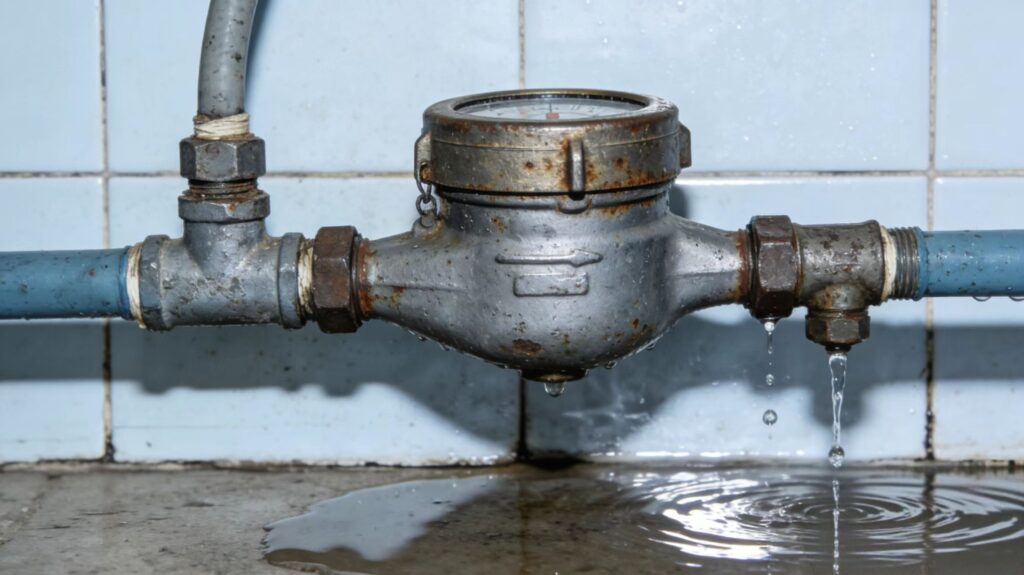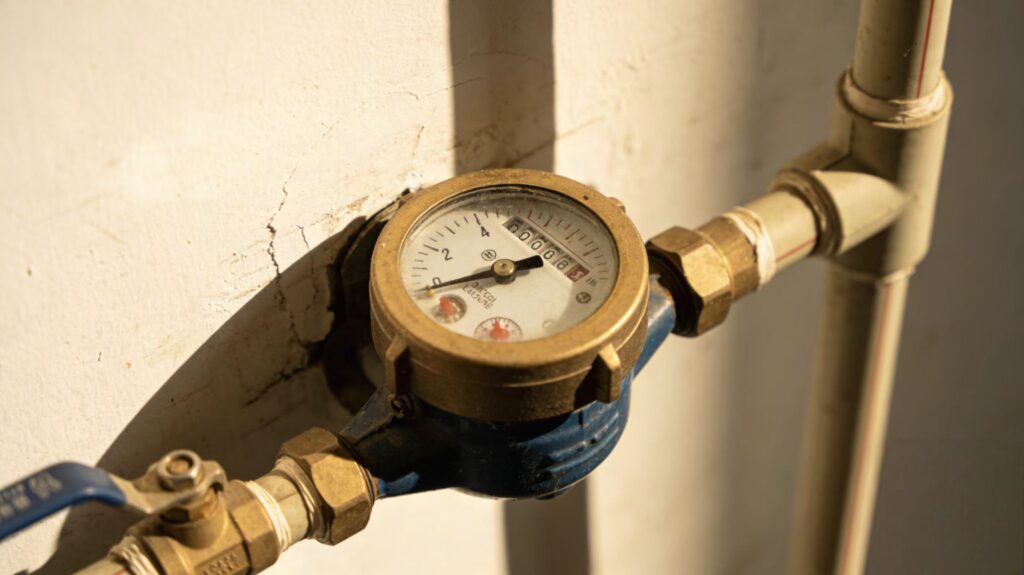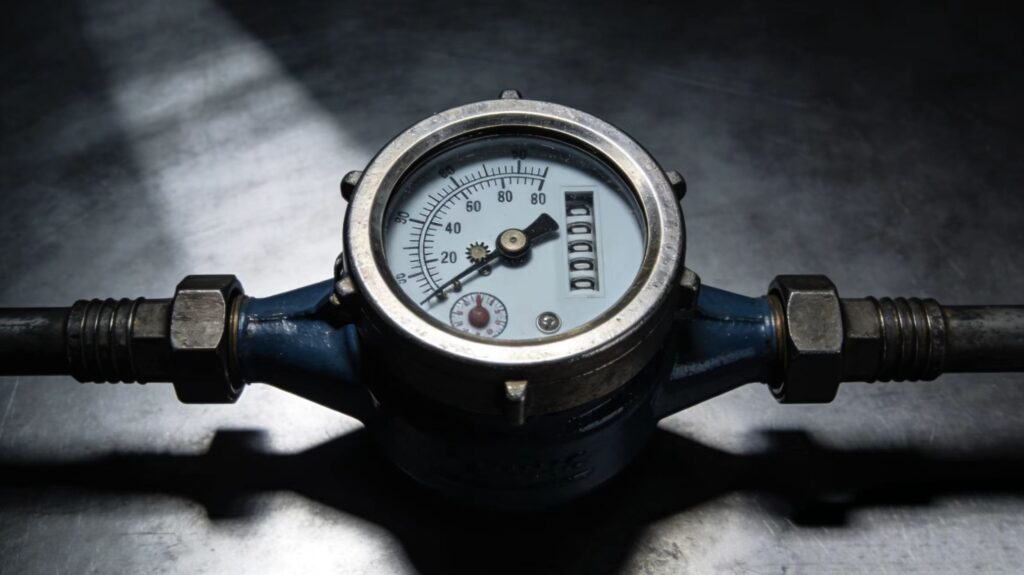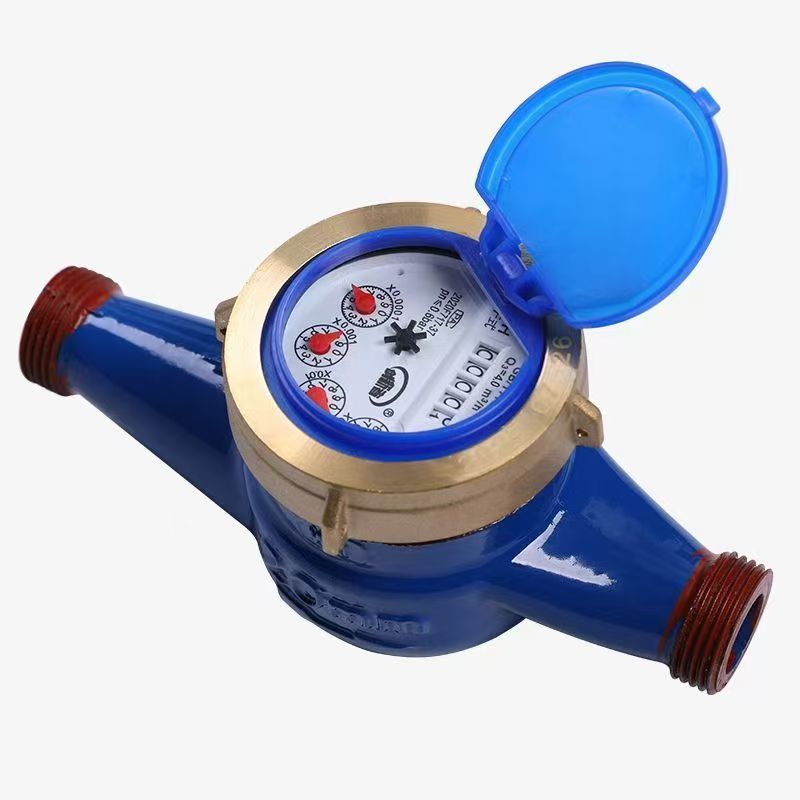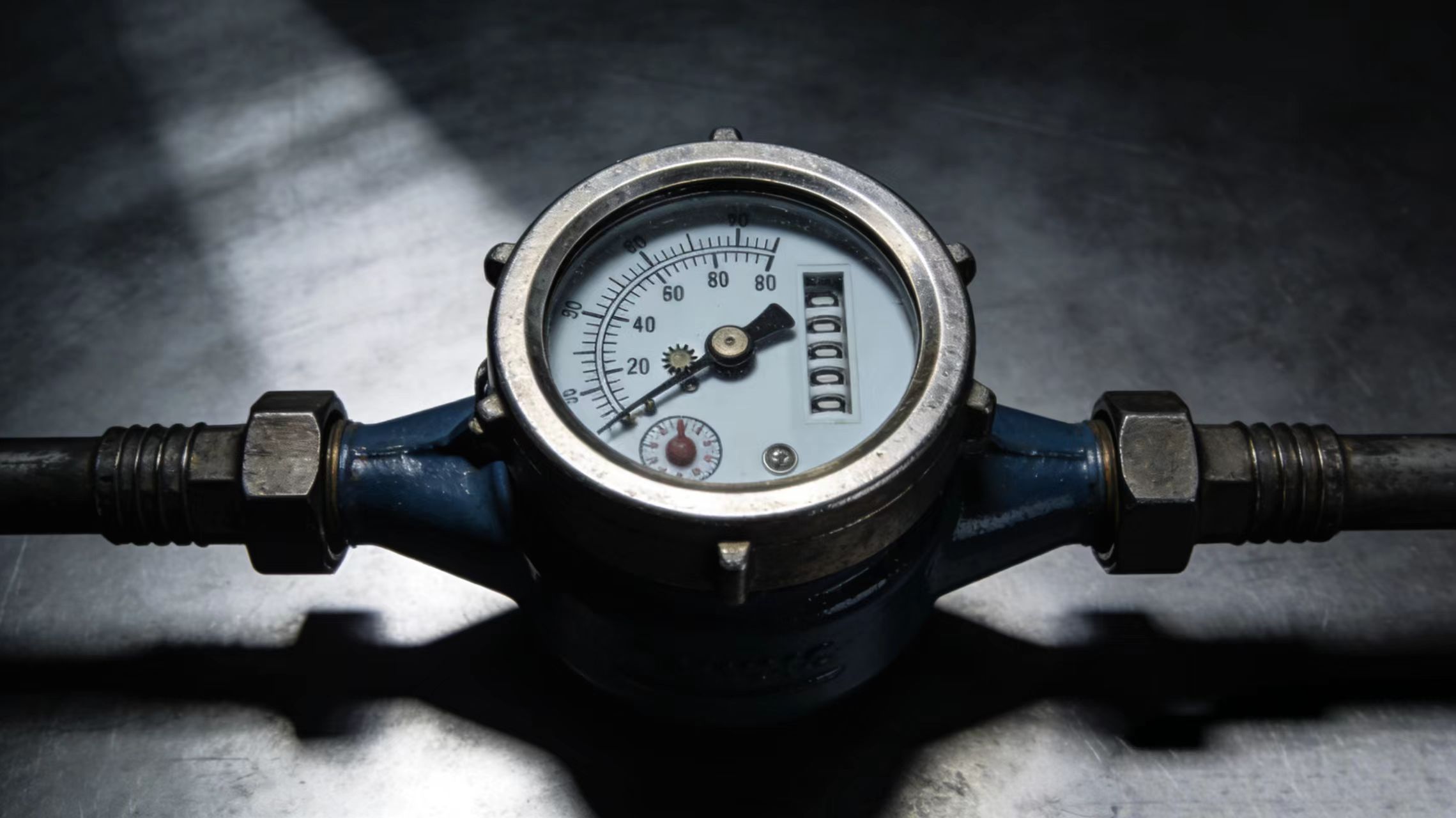
When you receive your monthly water bill, have you ever wondered how that unassuming device—usually installed in an outdoor pit or under your kitchen sink—manages to accurately record your water usage? Whether you’re a new homeowner, someone investigating a surprisingly high bill, or simply curious about this ingenious invention, understanding your water meter is the first step toward managing household water consumption and saving money. This article will break down every aspect of water meters based on industry expertise.
What is a Water Meter?
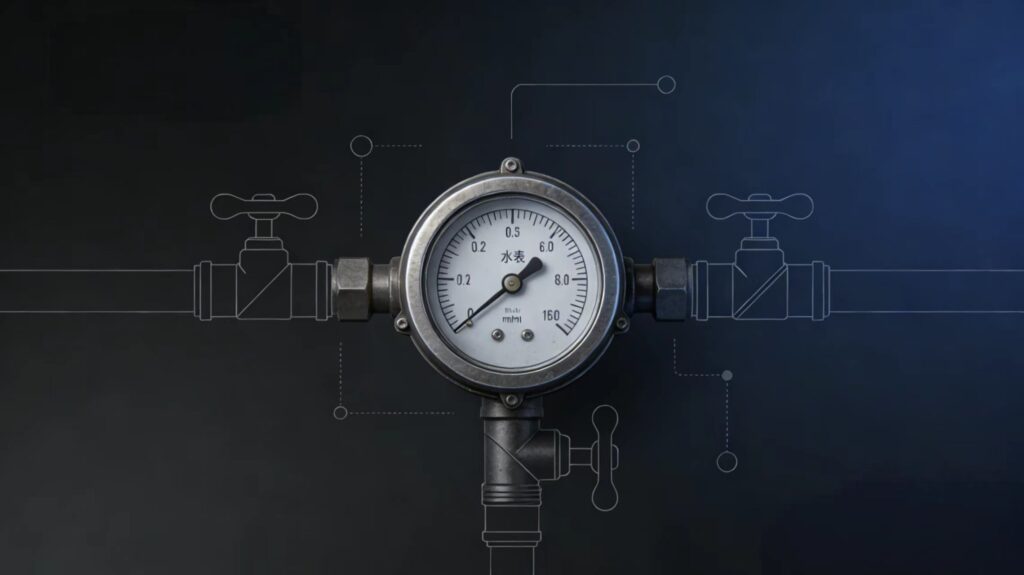
In simple terms, a water meter is an instrument designed to measure, totalize, and display the volume of water flowing through a pipeline.
In industrial and standardized terminology, it’s defined as “a measuring instrument used for continuously measuring, memorizing, and displaying the volume of water flowing through a measurement sensor under rated operating conditions.”
In China, water meters are classified as one of the “three civilian meters” subject to mandatory government regulation (alongside electricity meters and gas meters), playing a crucial role in trade settlement. According to the Metrology Law of the People’s Republic of China, water meters used for commercial transactions must pass mandatory verification before installation to ensure fairness for both suppliers and consumers. Typically, our water usage is measured in cubic meters, displayed on the dial as “m³” . Since one cubic meter of water at room temperature equals exactly one ton, this makes calculating water bills very intuitive.
Types of Water Meters: From Mechanical to Smart
As technology has evolved, water meters have progressed far beyond simple gear-driven counters. Based on their working principles and technological sophistication, they can be categorized into three main types:
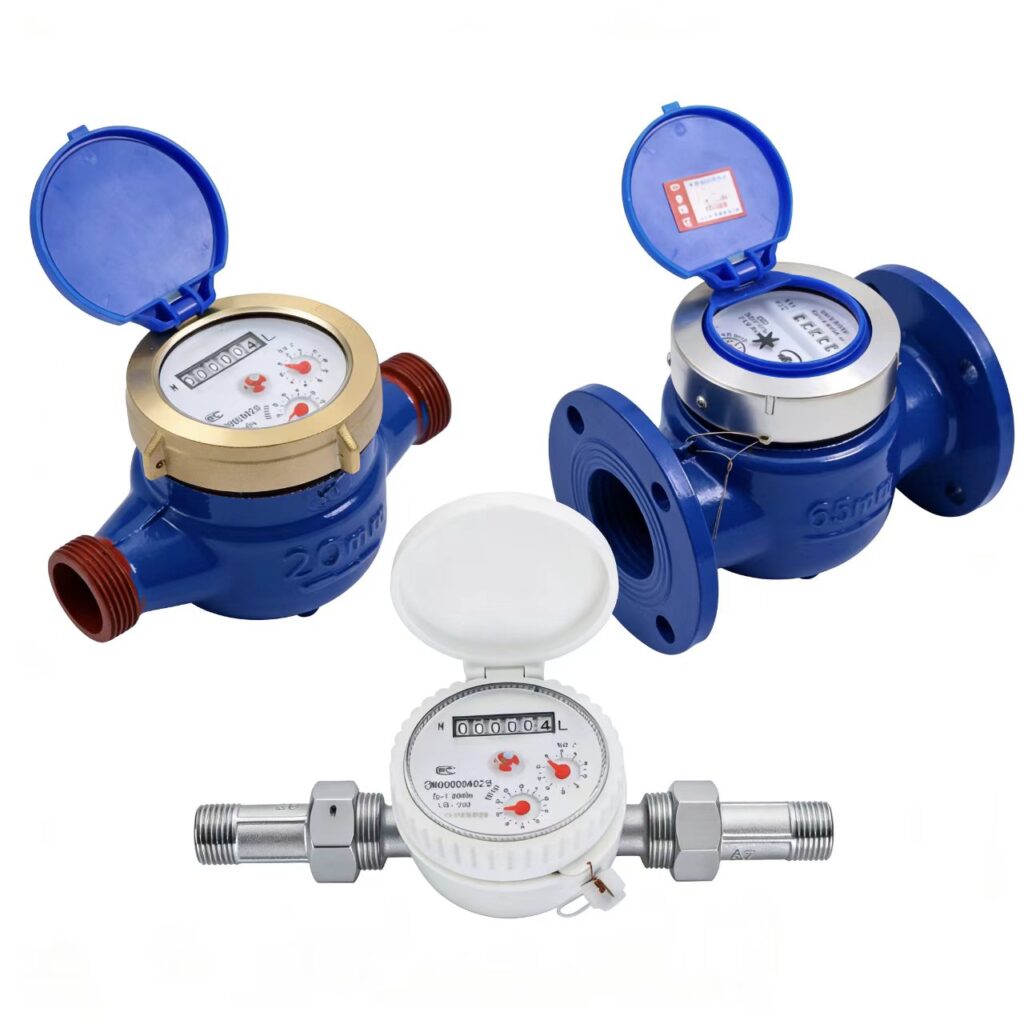
These are the most common traditional water meters, operating through mechanical components driven by water flow.
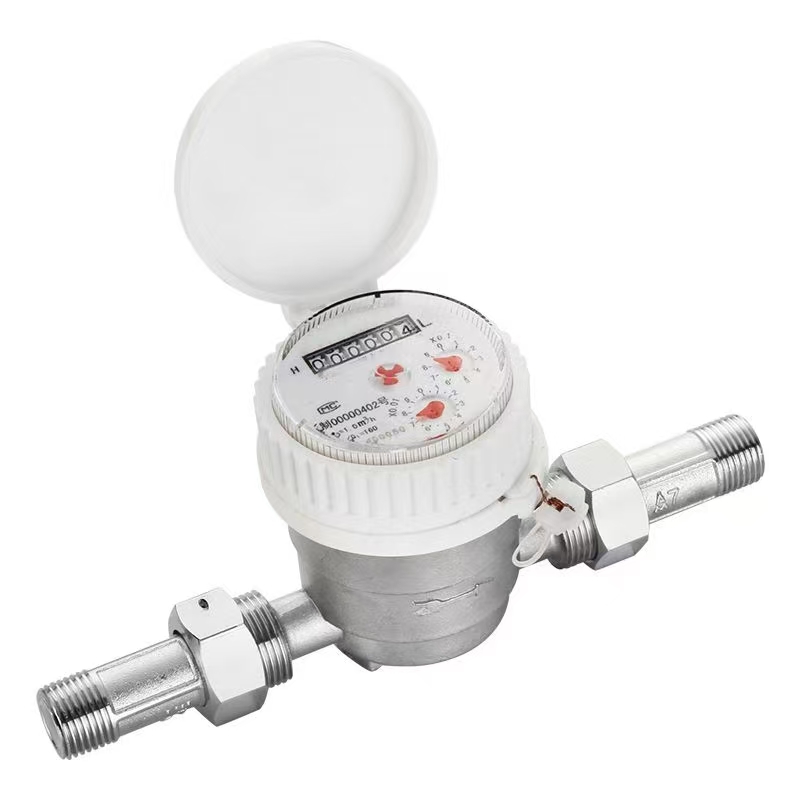
- Rotary Vane Water Meter: Water flow impacts the impeller, driving the counter. Simple structure, low cost, widely used for small to medium pipe diameters, suitable for household and SME water measurement.
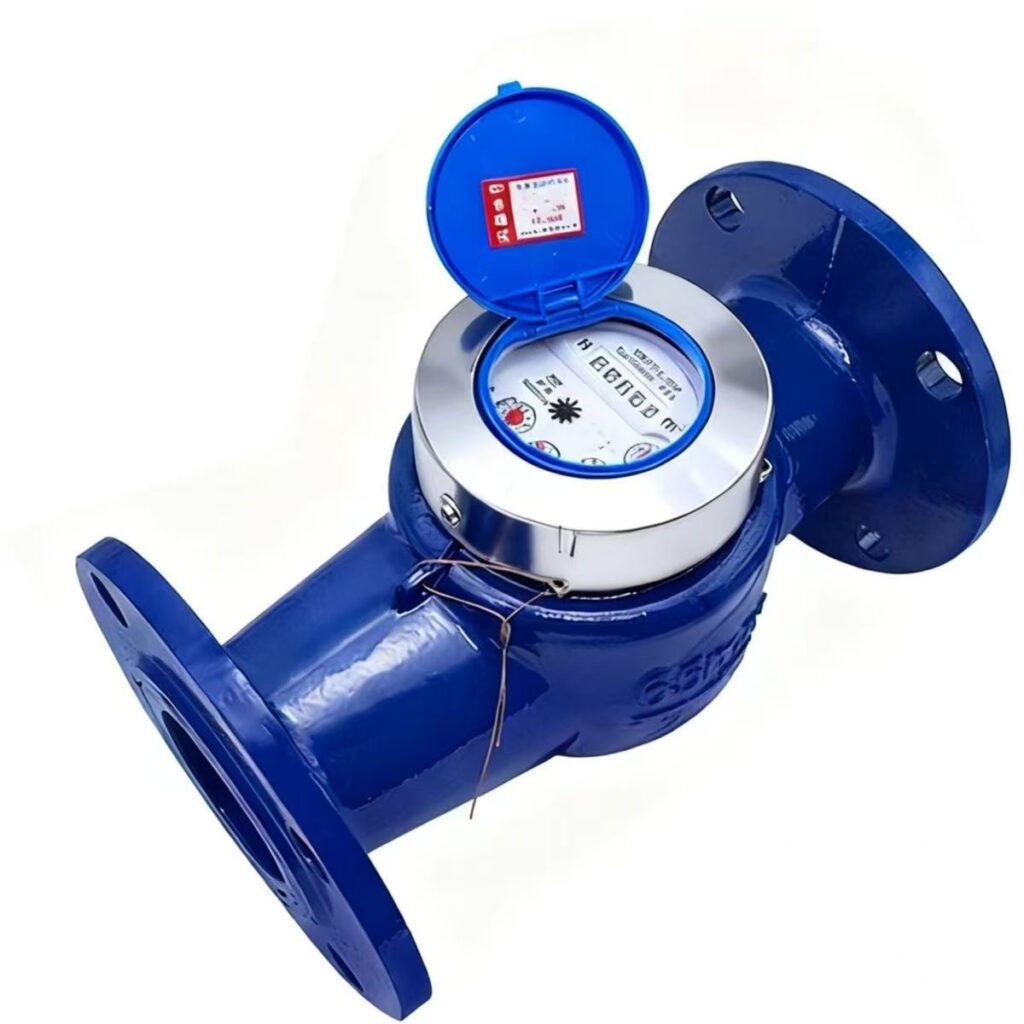
- Woltman Water Meter : Water flow axially pushes the propeller blade, offering high flow capacity and low pressure loss. Ideal for large-diameter pipes, such as main water supply lines in factories or residential areas.
- Volumetric Water Meter: Uses a precision measuring chamber that repeatedly fills and discharges a fixed volume of water, counting via a reciprocating mechanism. High accuracy but requires good water quality; suitable for metering scenarios.
2.Electronic Water Meters
These meters no longer rely on complex gear trains but instead utilize electronic principles for measurement. The most common types are electromagnetic and ultrasonic water meters.
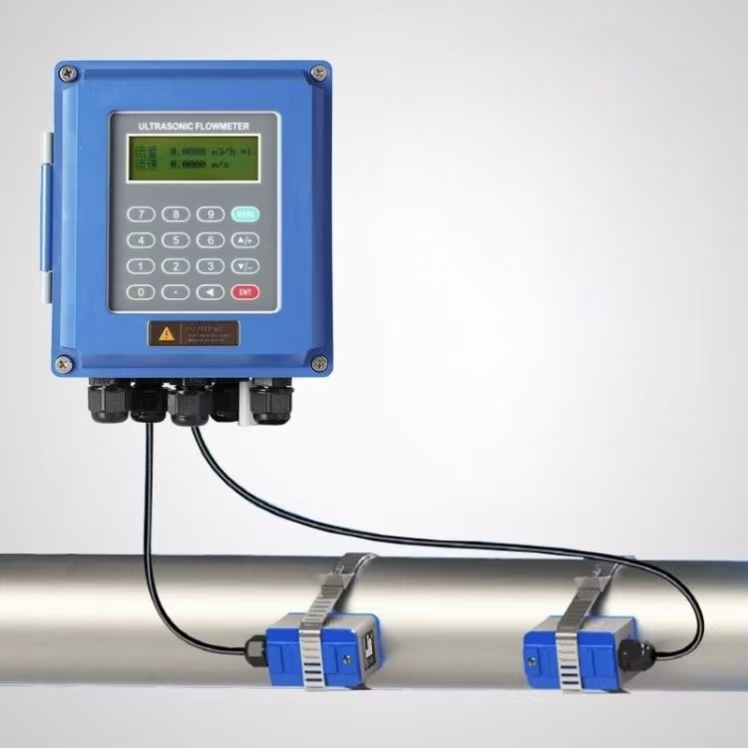
- Clamp-on Water Meter: Sensors clamp onto the pipe’s exterior for measurement, requiring no pipe cutting. Utilizes ultrasonic principles, ideal for temporary monitoring or retrofit projects where interrupting flow is inconvenient.
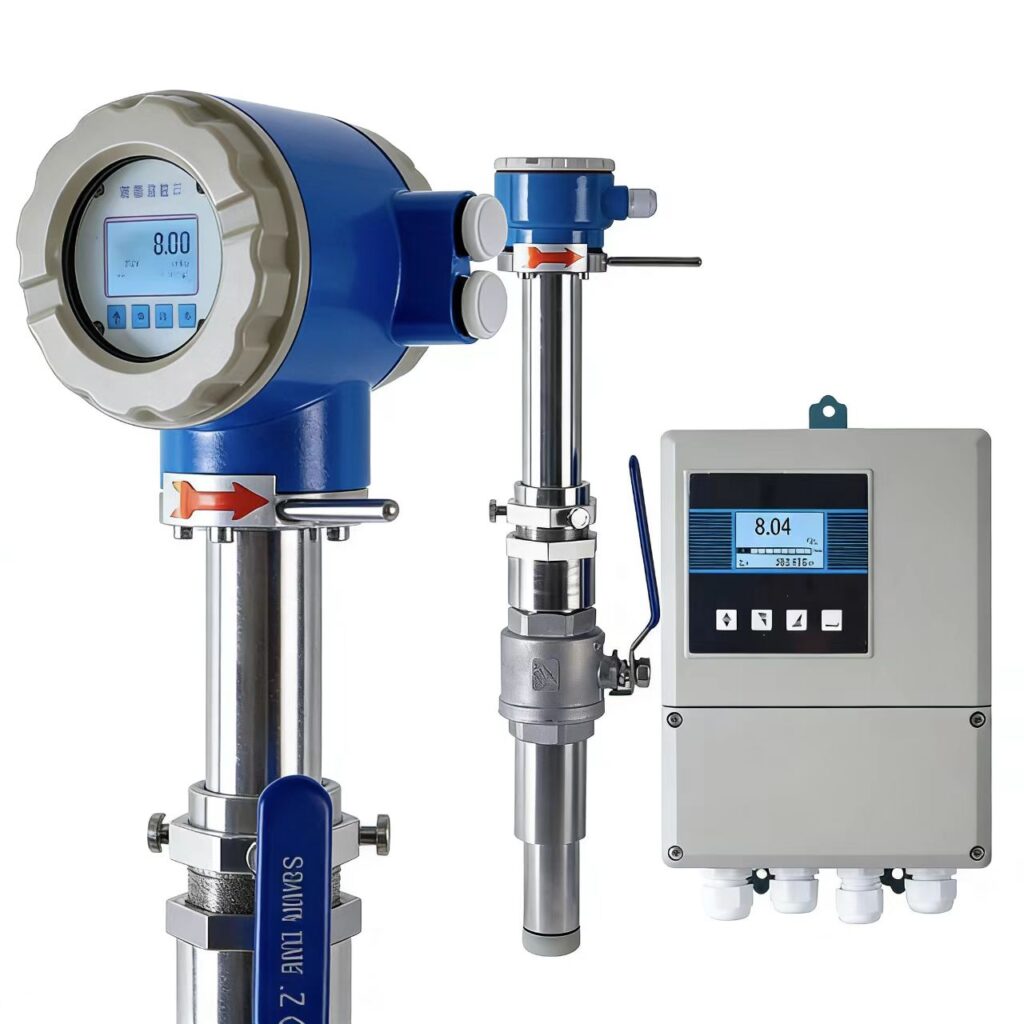
- Electromagnetic Water Meter: Based on Faraday’s Law of Electromagnetic Induction, it measures the flow velocity of conductive water. No mechanical wear, extremely high accuracy, suitable for complex water qualities and industrial applications.
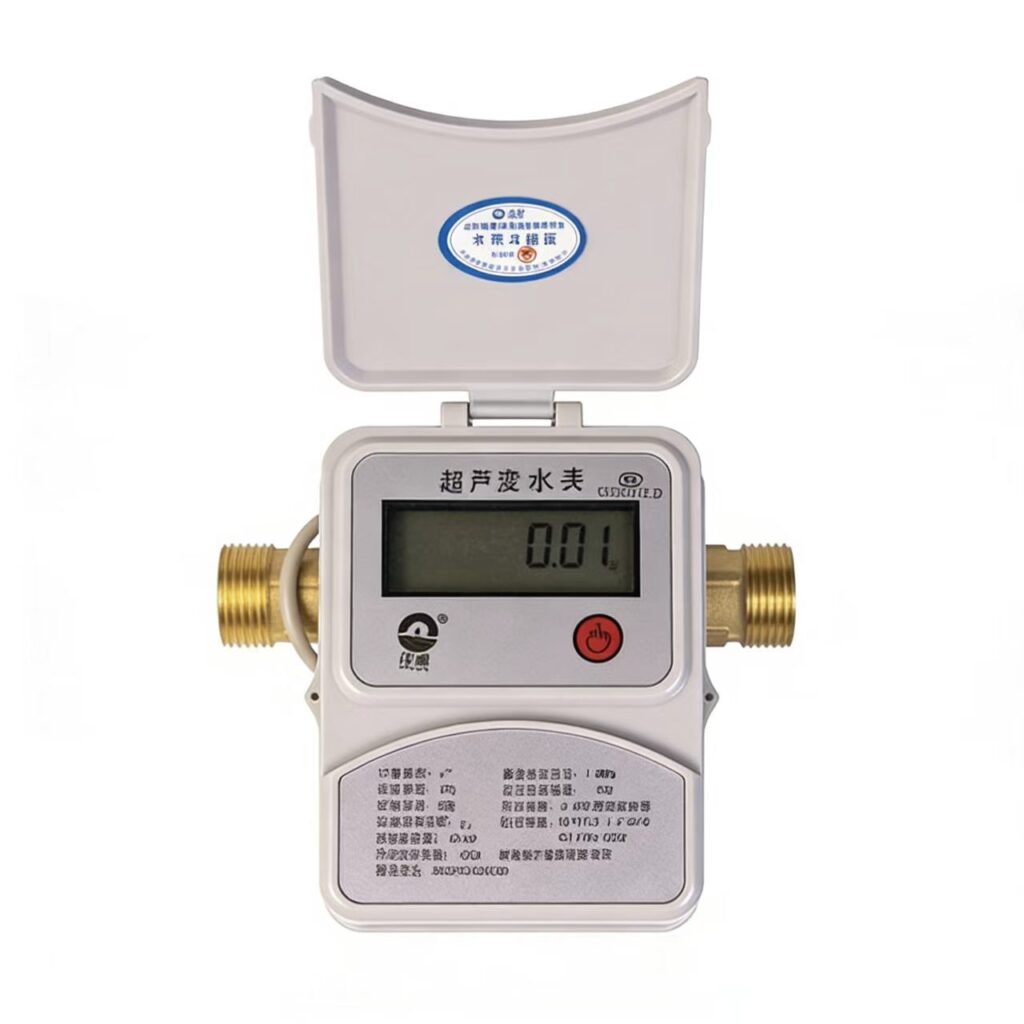
- Ultrasonic Water Meter: Measures flow velocity using the ultrasonic transit time difference method. No moving parts, low pressure loss, excellent stability, supports bi-directional flow measurement, suitable for commercial and residential use.
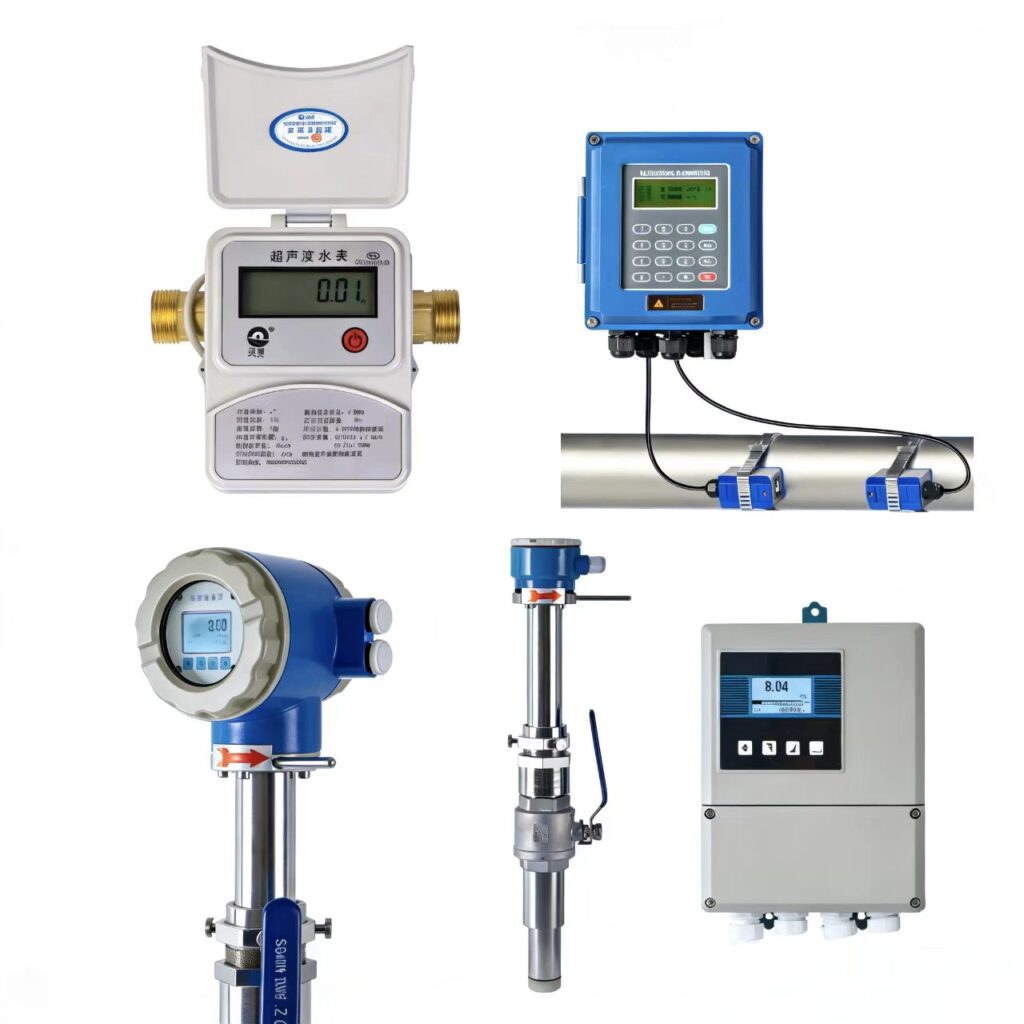
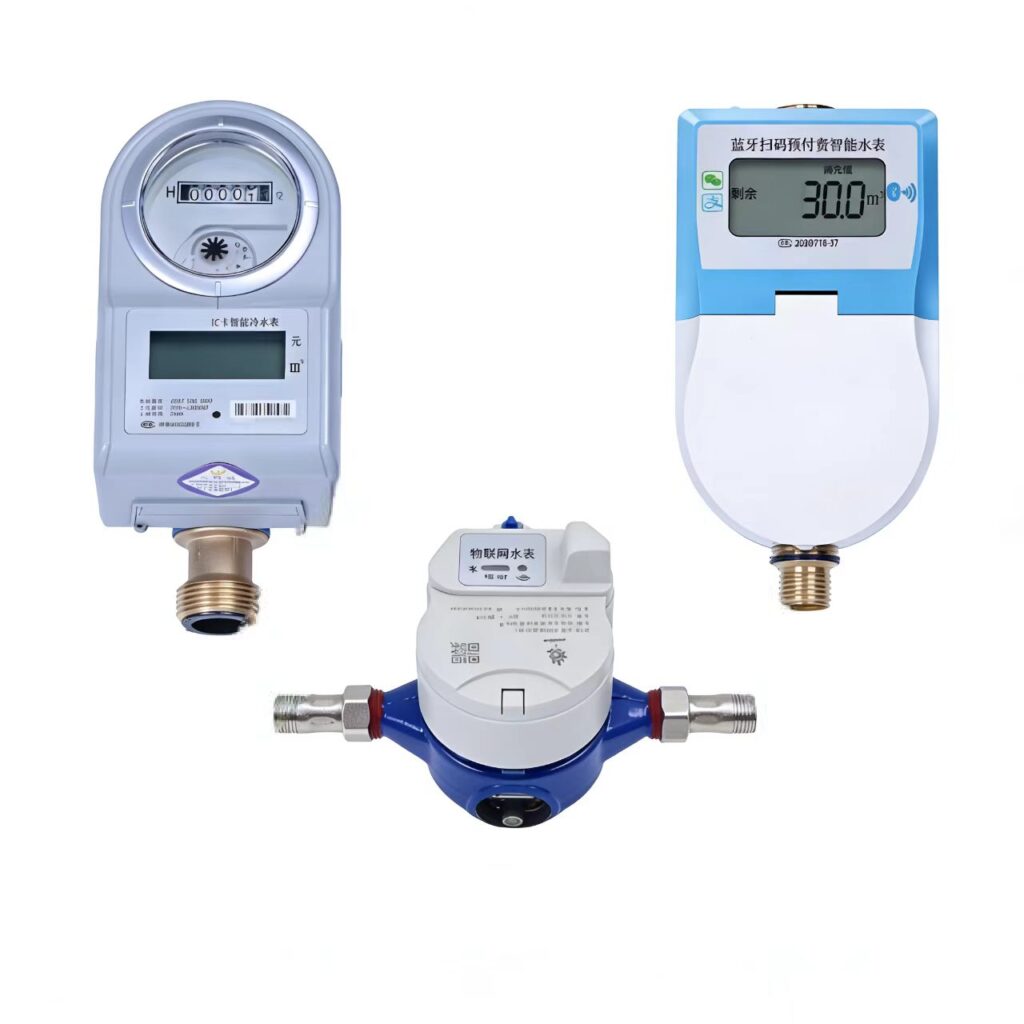
This is currently the fastest-growing market segment. Smart meters are typically mechanical or electronic meters enhanced with remote communication and intelligent control features.
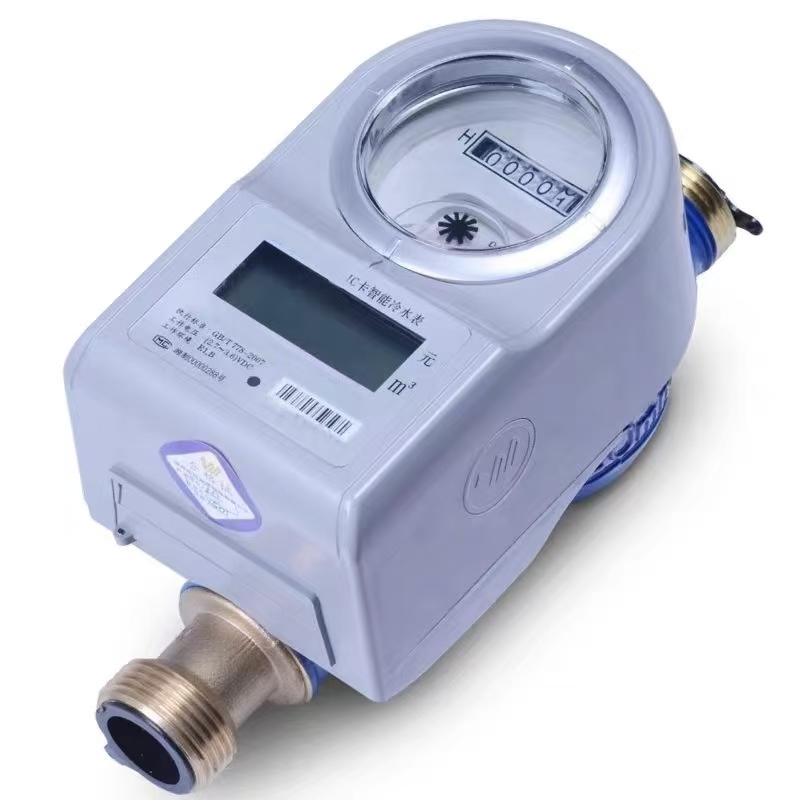
- IC Card Water Meter: Features an embedded IC card读写 module, enabling a prepayment system (pay before use) with automatic valve control. Facilitates water utility management, ideal for prepayment-controlled residences and apartments.
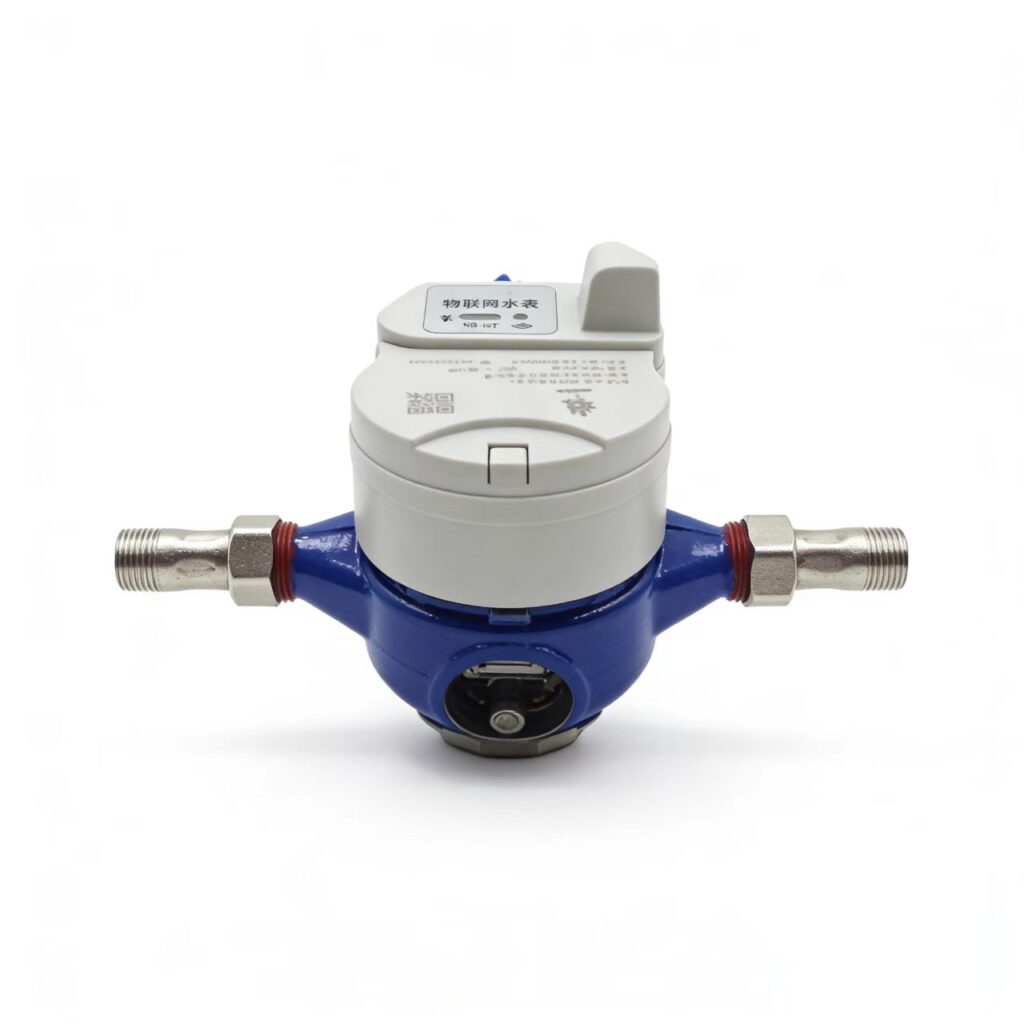
- Wireless Water Meter: Integrates NB-IoT or LoRa modules for remote automatic data upload, eliminating manual meter reading. Supports real-time monitoring, suitable for smart cities and remote areas.
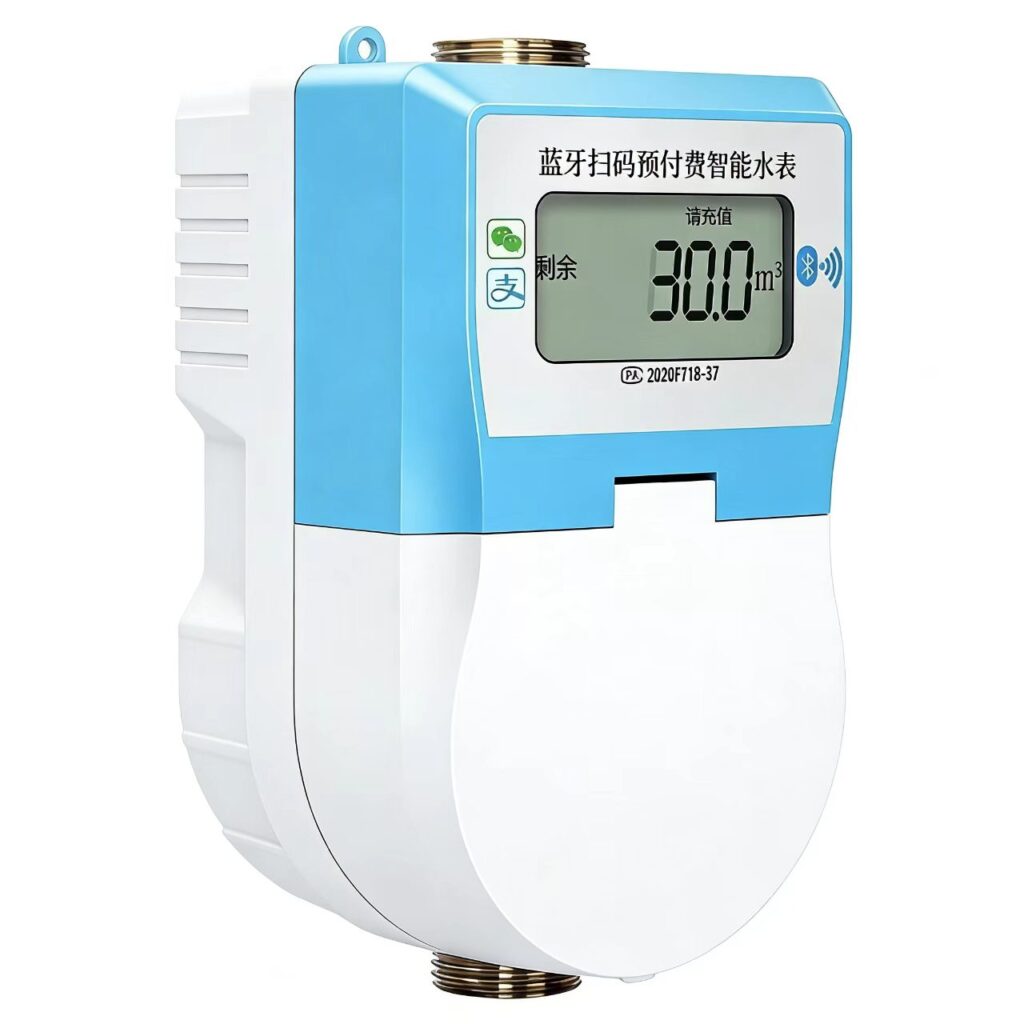
- Prepaid Water Meter: Controls usage through credit, automatically reminding users or closing the valve when balance is low. Helps users plan consumption, management in rental properties and commercial venues.
How Does a Water Meter Work?
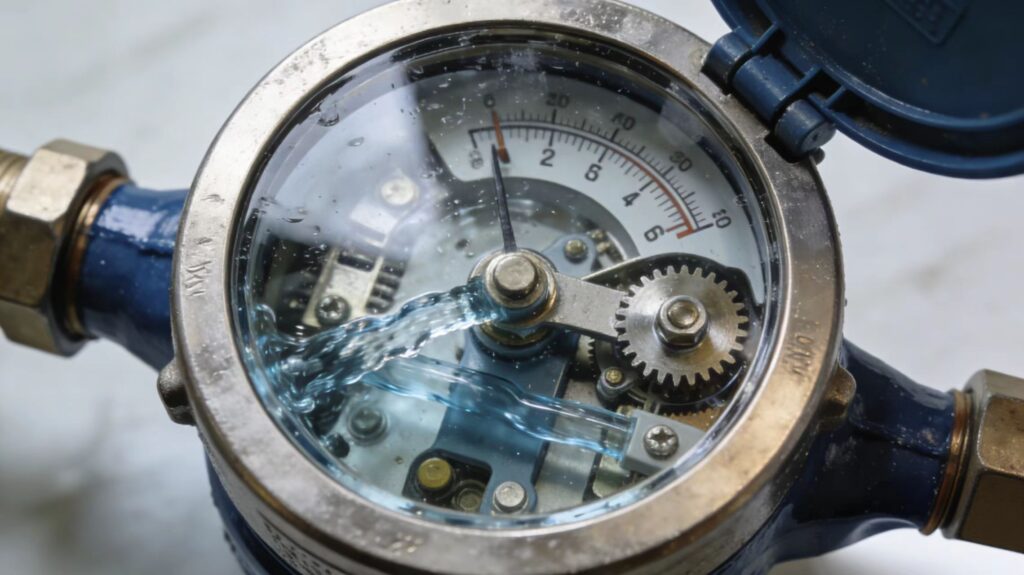
Although smart meters are gaining popularity, the most common type encountered today is still the mechanical velocity meter. Its principle is elegantly simple.
In essence, it relies on a purely physical process: water flow drives an impeller, and the impeller drives gears.
- Drive: As water flows through the meter body, specially designed channels in the casing direct the water to strike the plastic vanes of the impeller tangentially. This creates torque, causing the impeller to rotate.
- Transmission: The faster the water flows, the faster the impeller spins. Attached to the top of the impeller’s vertical shaft is a small pinion gear. This gear engages with a highly precise set of “decimal reduction gears.” This gear system, through specific gear ratios (e.g., 9:30, 10:30), progressively reduces the speed of the impeller’s rotation to drive different pointers or number wheels at the correct rates.
- Totalization and Display: Through this step-by-step gearing and carryover mechanism, once the unit pointer completes ten revolutions, the tens pointer moves one step. This allows the meter to accumulate volume from liters to cubic meters (tons). Ultimately, what we see on the dial is the total volume of water that has passed through the meter.
How to Read a Water Meter?
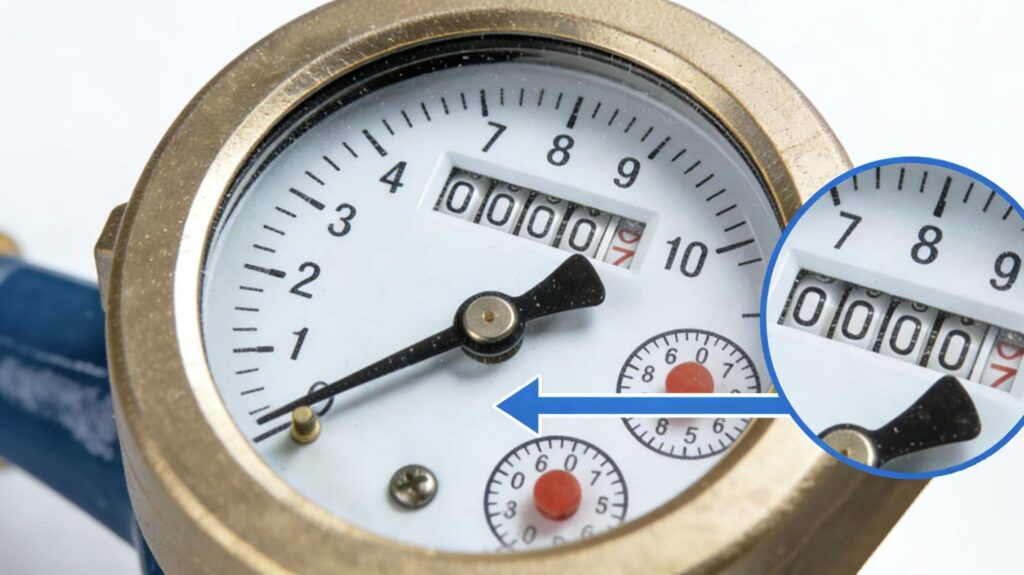
Reading a water meter isn’t complicated, but the method varies slightly depending on the type.
- Reading an Older Analog Meter (with dials and digits) :
This type usually features digital rollers on top and red pointers below. You only need to read the black digits from left to right. This represents your total usage in cubic meters (tons). The red pointers typically indicate measurements after the decimal point (e.g., hundreds of liters, tens of liters, liters) and are generally used for leak testing, not billing. - Reading a Digital Smart Meter:
- Open the meter cover. The screen is usually in sleep mode.
- Activate the Screen: Cover or bring your finger very close to the light sensor (usually located near the bottom right corner of the screen) to wake it up. At night, you might need to shine a flashlight on the sensor.
- Read the Data: The default main screen typically displays the cumulative water consumption, in m³. You can cycle through other screens by covering the sensor again to view instantaneous flow rate (m³/h), temperature, pressure, etc. If the instantaneous flow rate shows a value greater than zero when no water is being used, it usually indicates a leak.
How to Install a Water Meter?
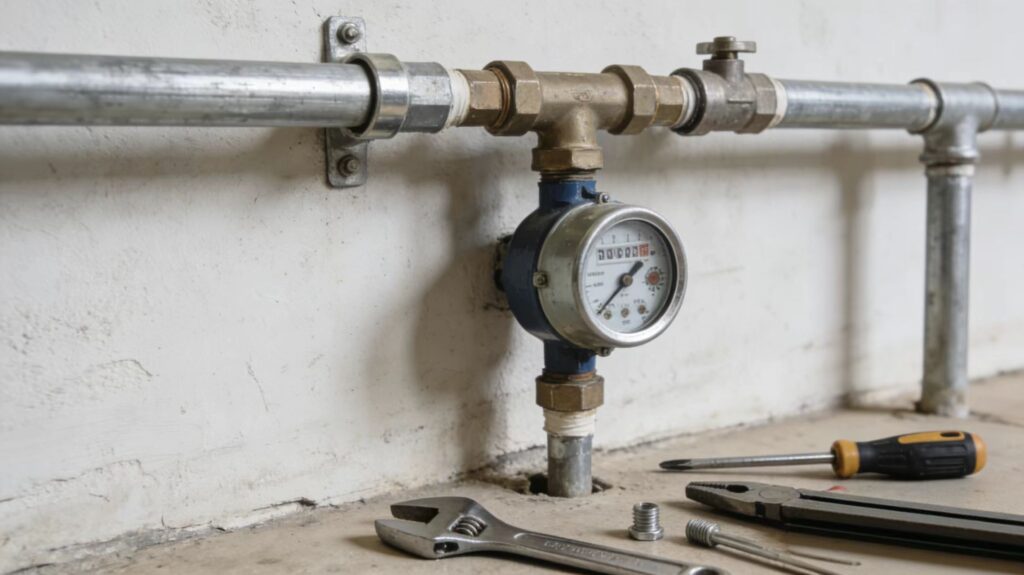
Water meters are precision instruments, and improper installation can directly impact their accuracy and lifespan. If you need to install a new meter, here are some key industry guidelines:
- Pre-Installation Preparation: Flush the pipeline thoroughly before installation to prevent debris like sand or gravel from damaging the meter. Ensure the arrow on the meter body points exactly in the direction of water flow.
- Location Selection:
- Choose a location that is easily accessible for reading and maintenance, and protected from contamination and freezing.
- Ensure Straight Pipe Runs: To guarantee stable flow conditions, there should be a straight pipe section of at least 5 times the pipe diameter upstream (inlet) of the meter, and at least 2 times the pipe diameter downstream (outlet).
- Avoid installing the meter at the highest point of the pipe, as air bubbles can accumulate and cause inaccurate readings. Install it at a low point to ensure the pipe remains full.
- Orientation Requirements: For horizontal installation, the meter dial should face upward. For vertical installation, the water flow direction must be from bottom to top to ensure the pipe is always full of water, preventing under-registration caused by partially filled pipes.
- Insulation Protection: For meters installed outdoors, proper insulation measures (e.g., wrapping the meter body with insulation materials) are essential before winter to prevent the meter from freezing and cracking.
How to Check a Water Meter?
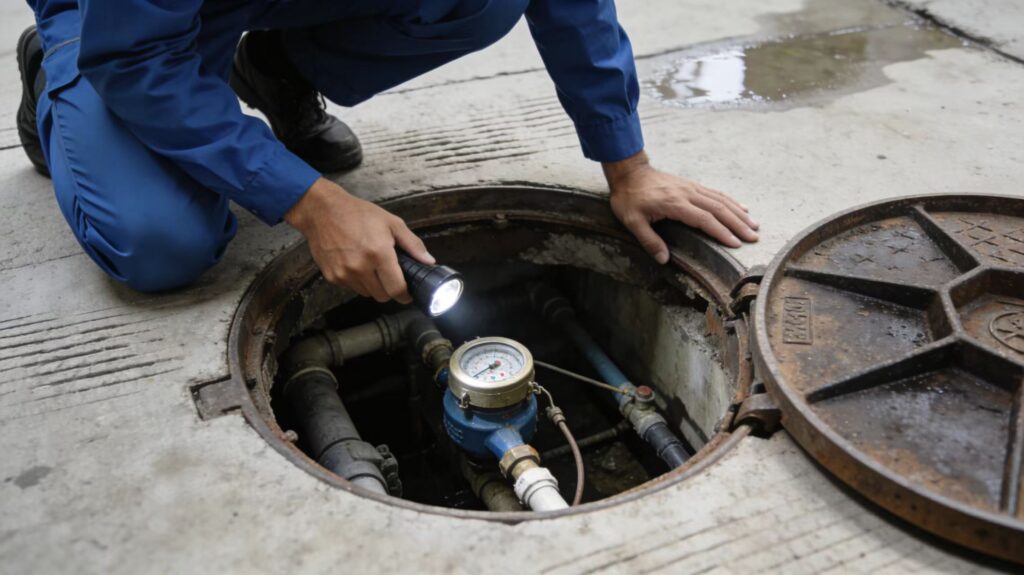
Regularly checking your water meter can help you identify potential hidden leaks in your home, preventing unexpectedly high bills.
- Leak Detection (The Essential Test) :
- Turn off all taps in the house and ensure appliances like washing machines and dishwashers are not running.
- Record the current reading on the water meter (note the position of the red leak indicator or the smallest digit if possible).
- Wait for 1-2 hours (or check before bed and verify in the morning) without using any water during this period (including flushing toilets).
- Check the meter reading again. If the reading has increased, it indicates a leak within your plumbing system.
- Simple Toilet Leak Test: Add a few drops of food coloring to the toilet tank. Wait 15 minutes. If color appears in the toilet bowl without flushing, the toilet flapper valve is leaking.
- Observe the Pointer/Leak Indicator: Even if all water is off, if you see the small triangular leak indicator or the smallest pointer on the dial moving slowly, it signifies a small amount of water is flowing, strongly suggesting a leak.
How to Replace a Water Meter?
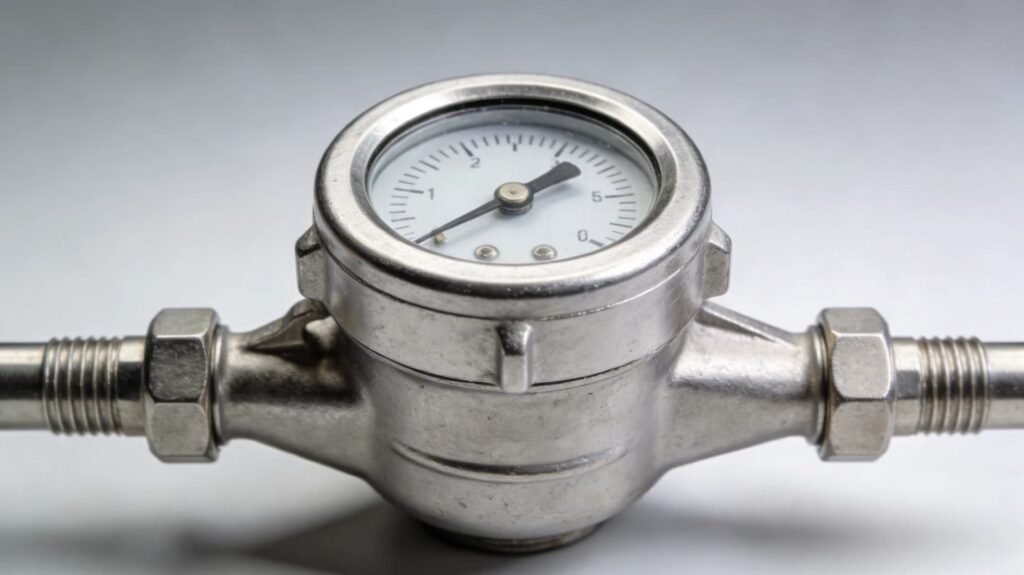
If you find your water meter is faulty (e.g., a yellowed dial that’s unreadable, internal noises, a leaking body, freeze damage) or has reached its mandatory service life (typically not exceeding 6 years), it needs replacement.
- Contact Your Water Utility: Usually, the ownership of the water meter lies with the water supply company, or they are responsible for its management. If you discover a damaged or expired meter, the first step should be to call your local water utility’s service line. A professional technician will come to inspect and replace it. Never attempt to dismantle it yourself.
- Considerations for Self-Replacement: In specific situations (e.g., a developer installing meters in a new building) where self-installation is necessary, you must use a meter that has passed mandatory verification. When installing, strictly follow the “Installation Guide” above, ensuring gaskets are correctly seated and connections are leak-free.
- Billing After Replacement: If your meter is replaced by the water company, you might receive two bills for the current period. One bill settles the account based on the old meter’s reading up to the replacement date, and another covers usage based on the new meter’s reading from that point forward. This is not duplicate billing.
Conclusion
From simple mechanical gears to today’s IoT-enabled smart terminals, the humble water meter embodies remarkable ingenuity and serves as a silent witness to our efforts in water conservation. Understanding your water meter not only demystifies your water bill but also empowers you to detect potential issues early. We hope this guide helps you become more knowledgeable about water and better equipped to manage its use in your daily life.
Authoritative References and Further Reading
【1】 Clear Springs Nourish Thousands: Insights on Rural Water Supply Metering, Tongling Municipal People’s Government, 2025-06-05
【2】 Automation Expo: Water Meters, China Popular Science Expo
【3】Understanding your water meter, Rous County Council (Australia), 2024-10-15